
Choosing the World We Live In
Objective or subjective, neither or both?

I presented an evening lecture on Activation at a local venue last week and fielded a question from a young man (in his 30’s). He explained that he was a college grad but couldn’t find a decent job, that he and many of his friends were struggling financially, living in vans to reduce rent expenses, and he wondered what I’d suggest to help solve their predicament. We spoke at length after the event and are planning to get together.
He suggested remedies like guaranteed annual income and free health care. I’ll be recommending something else: that he and his friends assume 100% responsibility for their lives, that they choose the world they are living in.
This may be a hard sell.
Victim mentality is woven into modern culture. It’s how the power hungry stay in power, it’s how we’re deceived at every turn, it’s how our natural urge to love each other is turned into polarized hatred.
Regardless of the physical reality, this young man is not a victim of a broken system and neither are his friends - unless they choose to believe that. There’s no bad guy in this movie (baby boomers, for instance, who did make a mess of running the world). And there’s no savior riding to the rescue, no Ultimate Solution to find and implement. That’s all a self perpetuating game that keeps most of us chasing our tails and missing the obvious, that we are all choosing the world we live in.
The world is the way it is? Is that true? Of is the world the way we perceive it? Glass half full, glass half empty? This is not a new idea.
This does open the classic debate: is reality objective or subjective? How we crave simple answers to complex questions! In this case, the answer is… objective or subjective or both or neither. How’s that for an all encompassing answer?
Truman Capote’s classic non-fiction true story In Cold Blood, written back in the 60’s, is acknowledged - decades later - as being pivotal in birthing the True Crime genre, fascinating readers and viewers with the now standard exploration of motive (In Cold Blood is the story of two murderers, their crime, their capture, and their punishment) and detailing the soap opera details of “who dunit and why.”
I’m mentioning this reference to illuminate the power of our choices. That story centers on two extremely damaged young men who killed a Kansas family. Why didn’t that story prompt a wave of compassion for the mentally ill and support the development of treatment programs that would help those afflicted and head off future tragedies?
Instead, this book and how it was leveraged, ended up promoting gratuitous violence and seductive intrigue, while those in power chose to develop drugs to quick-fix sufferers while ignoring deeper causes of mental illness, which includes fundamental identity confusion.
We just don’t know who we are. We don’t know that we are creators, that our choices create our experienced reality. (So much for my objectivity! Busted!)
In air navigation, there’s something called the “1 in 60” rule that helps pilots course correct. The principle is simple: because small deviations over time result in large ones, the standard strategy is to course correct early and constantly, to stay close to the accurate trajectory and arrive at the destination on time.
Pilots do that effectively on every flight. We’re not as efficient with our lives. And, in many ways, modern society is a bleak depiction of just how far off course a culture can get when course correction is not done early.
There are so many examples but I’ll choose a deeply controversial one: gender affirming care, as it’s called. The Human Rights Campaign defines gender-affirming care as “age-appropriate care that respects the autonomy and dignity of transgender and gender-nonconforming youth.” Apparently, according to The Williams Institute, there are 300,000 teenagers in the US today who need gender affirming care. They post this statistic on their website:
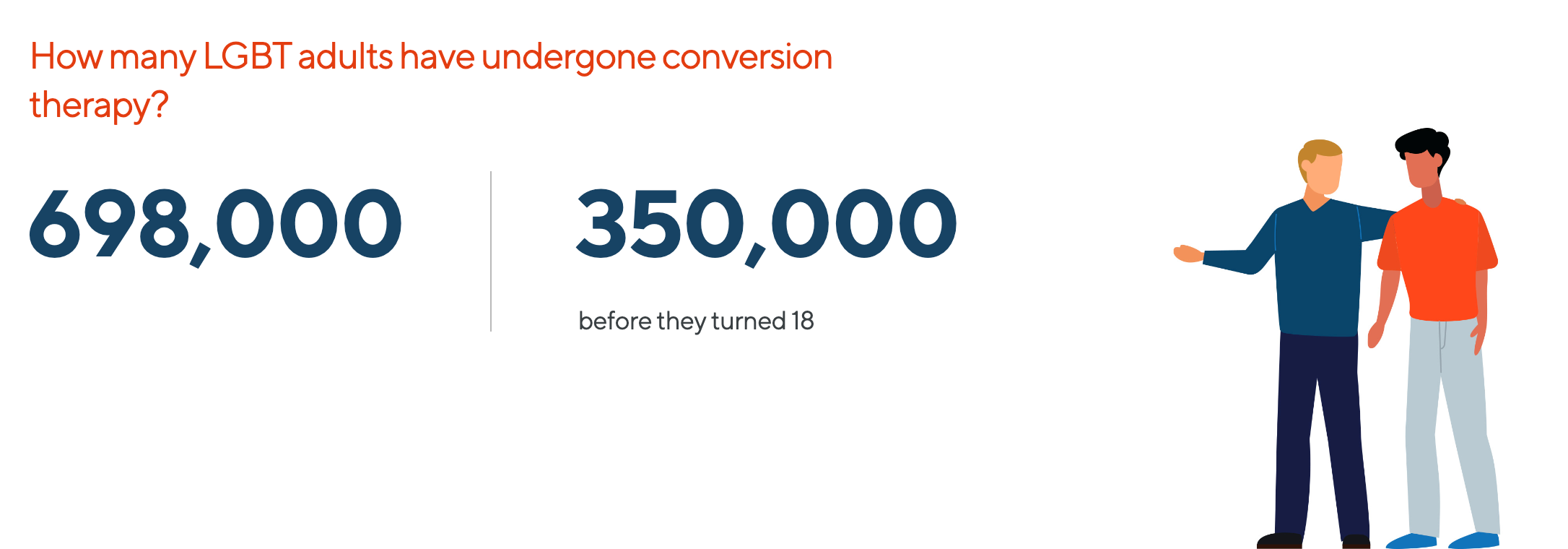
How did this come to be a thing? Is this “normal?
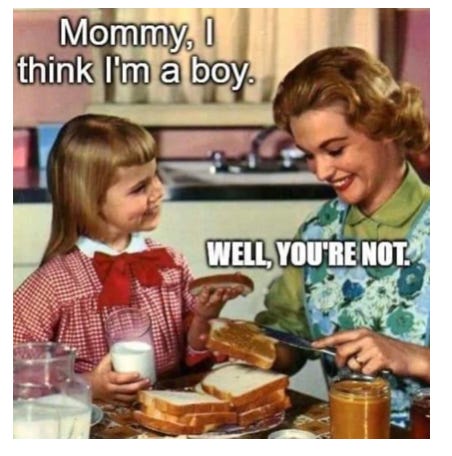
You may have seen this cartoon. I’m posting it here, running the risk of stirring up even more controversy, but it helps make an important point.
Those who advocate for puberty blockers and surgery to change sexes argue that it reduces depression and suicide. There are no valid long-term studies so it’s probably too soon to know for sure. But what we do know is that anyone who commits to aggressive intervention is changing their course … for life. Forget course correction. Surgery is permanent. And the related drugs, complete with their side effects, will be taken for life, as I understand it. I may be misinformed, please let me know.
Might there be other ways to address depression and suicide that are less intrusive, with fewer side-effects? Of course. But we haven’t chosen that direction, just like we didn’t choose to study and treat mental illness after In Cold Blood and instead make tv shows about criminals.
That cartoon from decades ago reminds us of a simpler time when issues like this were handled very differently. Some people will protest that this mother was ignoring her daughter’s valid question and not honoring who she might really be. Many others will say, “No, she was just being the wise parent for a child who was questioning her identity, as we all do at that age.” And, of course, the cartoon doesn’t address what followed after. Ideally, this mother would have engaged in a heart-to-heart with her daughter, to learn what this child was thinking, feeling, wondering about. And that could have led to something wonderfully helpful for this maturing being.
Confusion is normal when we’re growing up. But we seem to have chosen to see it as a problem to fix with counseling, drugs, and surgery. Could we have chosen differently? For sure. Adding in some compassionate care that helps young people learn who they really are (a spiritual being in a human body) doesn’t mean eliminating these other forms of care, but it could help a boat load of young people make a different choice.
The controversial Tavistock center in the UK, offering gender surgery services, offers a cautionary tale which, hopefully, those in position to influence future choices will pay attention to. Of course, we have to wonder how much of what’s developing here in the US is profit motivated (it’s a huge new business in the early stages) and why we persist in not going upstream to discover and treat the deeper causes of gender confusion (and identity confusion in general).
To be clear, I am not against or for anything. I am diving deeper. I’m musing about a much larger issue, course correcting away from manipulating our external environment (including changing our bodies), and supporting each other to know that we are creating our reality with our choices. Obviously, we can’t always control what happens but we can control our responses to what’s happening. But so many of our choices are made without sufficient understanding and certainly 14-year-old’s have very limited life experience, which means that they need guidance. But that guidance should be something other than a parent or counsellor’s personal opinions based on their own flawed programming.
I can’t know what anyone else should do. But I can help anyone who shows up in my life - like this young man I’ll be getting together with next week - to understand this central principle. Regardless of the specific issues, each of us is creating our experience through our choices. Are there limitations? Obviously. Do we all start on a level playing field? Obviously not. But this creative principle is true for all of us.
Objective, subject, neither or both? I hope this handful of words stirs the pot and, rather than delivering my version of “the way it is,” stimulates your thinking. I’d love to hear your thoughts. It’s such an important discussion on so many levels. There’s no simple answer, but opening our minds and hearts to learn and perhaps even change our viewpoint… that’s called growing up, at any age!
Thanks for this Lindsay. Sure, would love to read that paper, thanks. Well, common sense has become so uncommon! And ideology seems to trump practicality in crazy ways. I just keep exposing what seems to be obvious but denied, and engaging readers/friends in thoughtful conversations about "what if?" I know there are millions of us who are open minded this way. Hopefully, we can help those who are awakening to something more than the blame game.
Right on, great poem Mike.