
The Imaginal Touch
We are dying to live...

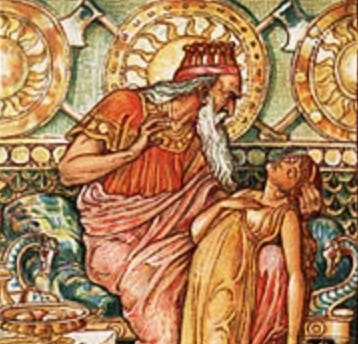
The ancient story of King Midas can help us understand something vitally important about our current human adventure. According to the Greek legend, King Midas begged the god Dionysus to grant him a special power, that everything he touched would turn to gold.
His wish was granted. But Midas soon discovered this was a curse, because everything he touched turned to gold, including his food and his daughter. Now he pleaded with Dionysus to reverse the spell and was instructed to bathe in the river Pactolus. He did and the gift/curse was dispelled.
That river carried gold dust from Mount Tmolus in Western Turkey. It’s interesting that this was the river Midas surrendered his power to, releasing what was personally held (gold for himself) so it could flow freely to others. Is that a lesson for us today? Are we like King Midas just before he realized that his gift was a curse, and chose to give it up?
We don’t give up what we value easily, even after we’ve realized that it’s harming us. Example: In his book, Full Catastrophe Living, Jon Kabat-Zinn related how farmers in India discovered a way to trap monkeys who were destroying their crops. They would cut a small hole in a coconut and place a banana inside. A monkey would smell the banana and poke his hand in to get it. With his fist clenched, he couldn’t get it out of the coconut. Refusing to let go of the banana, he could be captured. Hmn…
Both stories expose our modern dilemma: we cling to what we don’t want to lose, personally and institutionally. Innovation that improves things is usually met with mainstream resistance rather than enthusiasm. For example, sustainable energy initiatives get pushback from the oil industry. A suddenly discovered better medicine threatens the cash flow from an established brand. A strategic organizational improvement is obstructed by those who might need to change their work habits or who could lose their jobs were the improvement implemented.
The stakes are even higher personally.
We resist losing our familiar identity. Dr. Joe Dispenza, first encountered in the film, What the Bleep?, wrote a book called Breaking the Habit of Being Yourself: How to Lose Your Mind and Create a New One. That book, released 11 years ago, accurately predicted the two intertwining themes of current human experience:
1. We are struggling to hold on to who we’ve known ourselves to be.
2. We are inevitably evolving into who we are destined to become.
The first one gets all the attention, obviously, because - without confidence in resurrection - who would willingly commit to what looks like death? Even if what’s dying is separate, polarized humans in conflict with each other in an escalating conflict that could result in eventual species annihilation. A.I. offers an alternative alternative solution: assisting humans to become cyborgs, controlled by elite decision makers via technology.
That’s a transformation into slavery that I do not choose.
The problem with the real one - captured in the caterpillar to butterfly metaphor - is timing and convenience. The human version of that transformation is a messy, drawn out process, not especially enjoyable. Plus, it seems so theoretical, so ethereal, while our real-life challenges are … real. Who can really put their faith in that metaphor when the economy is crashing, prices are sky high, our jobs may be threatened, the climate is changing, wars are raging, gender dysphoria is exploding, virus are mutating, we don’t feel so good, and shadowy elites are plotting the replacement of humans with cyborgs… yikes! Our best response is to sit and meditate and hope to fly … someday? Really?
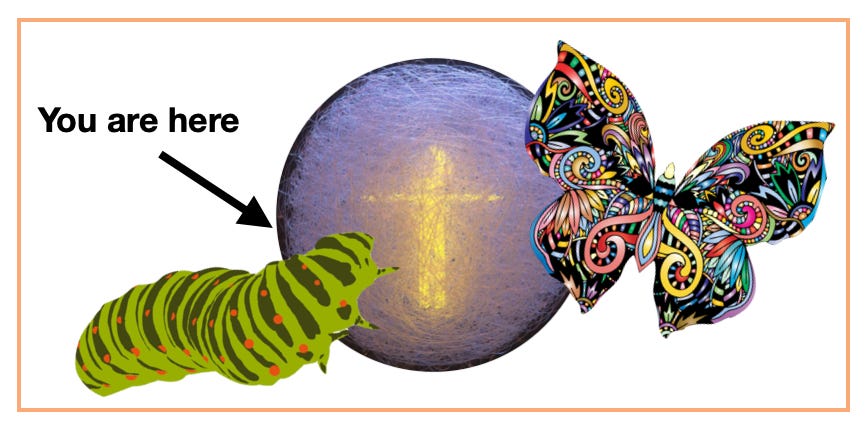
Worst of all, that once comforting metaphor has become a nightmare because it’s becoming painfully obvious that we humans are just entering that in-between cocoon stage not leaving it. This is the stage where the caterpillar dissolves into goo and literally consumes itself before transforming into the butterfly. That sounds just like I feel some days!
And, sorry, but the Age of Aquarius is still in the dark of early dawn.
We can expect more disintegration, institutionally and personally. Knowing this, we can quit defending against the loss of “self” and actively welcome a new “Self.” This new Self will not be locally defined, it will be spiritually tribal, that is, a communal identity based in spirit. I/we will be all inclusive, with no one and nothing excluded.
This happens gradually in the caterpillar and likewise in us. “Imaginal cells” develop that stimulate other caterpillar or human cells to transform, which increases the number of imaginal cells towards an eventual tipping point, where the butterfly / new human can begin to form and eventually fully manifest.
Are you an imaginal cell?
If so, you already possess The Imaginal Touch. Your very presence kindles the fire of transformation in others. But you need support because your own fire is burning away the construct of your old identity and that’s unnerving, to say the least.
Obviously, none of us can make this transformation from isolation to oneness on our own. So, calling all imaginal cells! Let’s support each other and collaborate to help others. This happens in the simple moments of our living, being the light shining in darkness and knowing this is our primary contribution.
BTW, unlike the Midas Touch, the Imaginal Touch has no down side, no harmful side effects.
Thank you for your commitment to this journey, you are making a difference, on your own and in community with others. This is not magical thinking, it’s evolution. Spiritual evolution. Have faith, the new you is gestating in the womb of your limitations and confusion and suffering and birth will come…
You can't get it wrong and you'll never get t done! What a great way to run a Universe.