
What If?
Reclaiming curiosity


Something interesting has happened over the past four years. (Now, there’s an understatement!)
Most of us used to trust the experts. Whether they front-lined science, economics, politics, health, or media, them seemed to know what they were talking about, were genuine in conveying true, important facts, and had our wellbeing in mind.
That was the norm. Not any more, right?
This article provides a compelling example. Writing for Forbes in 2020, the author cautions against “doing our own research.” Ironically, four years later, his article appears fundamentally flawed, bloated with inaccuracies warned about by people doing their own research.
BTW, that too used to be the norm and still is. Shopping for a used car? Comparing products on Amazon? Picking a movie on family night? We do our own research.
Because so many people are beginning to question the experts on bigger social issues as well, “fact checkers” have proliferated, presumably to dispel “misinformation.” But many of these have been exposed, like Snopes - a previously respected online misinformation buster. When this mom and pop operation, started and run by a now divorced couple, was fact checked, a sordid scenario emerged: embezzlement, prostitution, and thoroughly unqualified and politically biased employees. Although they’ve been thoroughly discredited, millions of people continue to consult their website, which remains active and appears legitimate.
Now there’s “deep fakes,” defined as “a type of synthetic media that has been digitally manipulated to replace one person’s likeness convincingly with that of another.” Here’s a video clip of former President Obama saying ridiculous things. It looks like him, it sounds like him, but it’s actually film director Jordan Poole speaking the words coming out of Obama’s mouth.
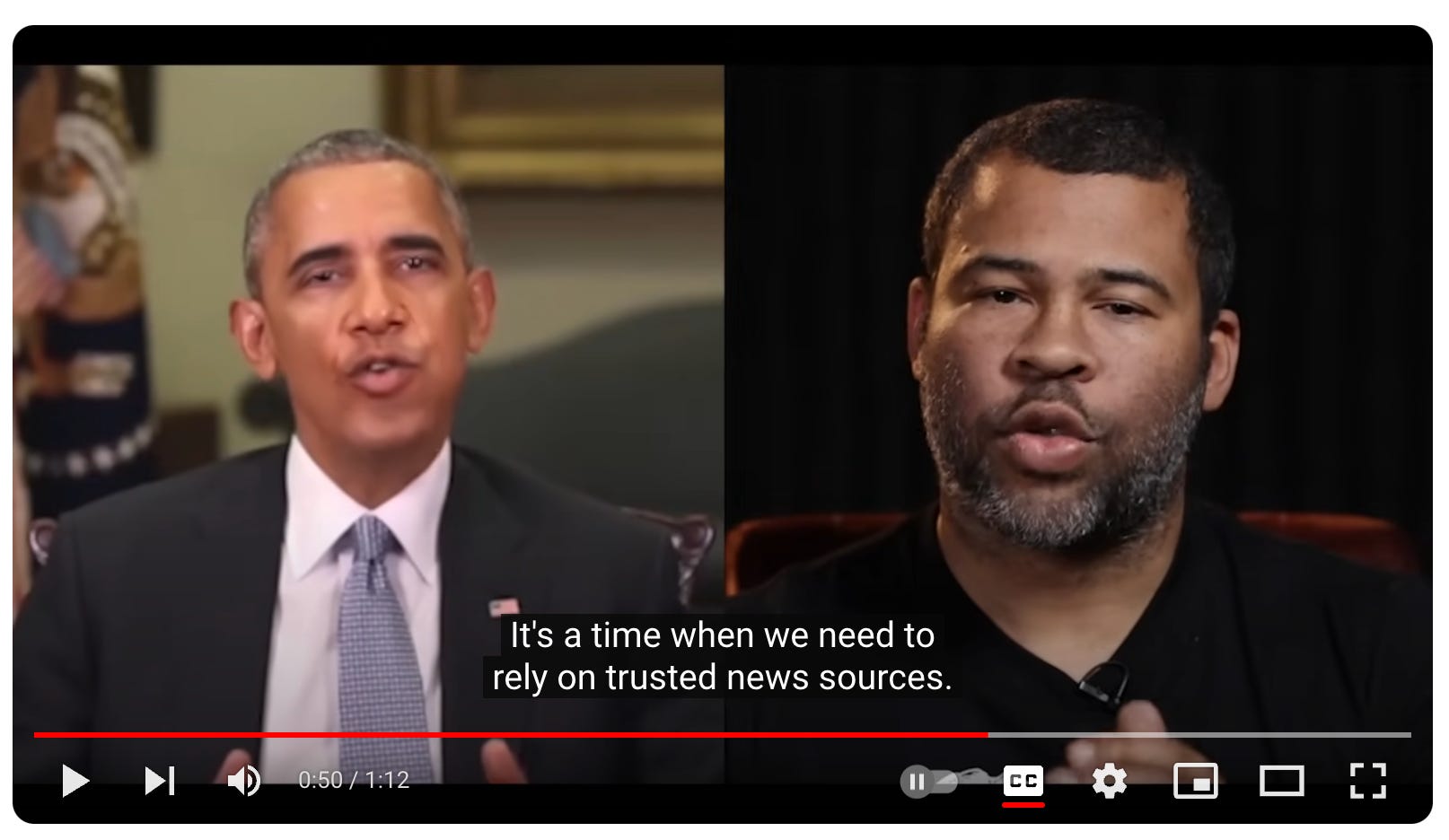
It’s becoming vitally important to question what we see, hear, and read, contrary to the advice printed out on the screen above. After all, what exactly is a “trusted news source?” Who’s the sponsor? What’s their agenda?
What if?
This is the mantra of an open mind. Instead of automatically accepting or rejecting something, we can question. But we have to make sensible distinctions. For instance, we don’t question which side of the road to drive on. However, we might switch sides, should an obstruction block our way, as long as it was safe.
Yes, there are laws, societal conventions, and well informed experts to guide us but, ultimately, we do need to do our own research. It’s called being personally responsible, which means that we’re also personally accountable.
This is also a key to avoiding or resolving conflict in our relationships. Instead of shutting down or arguing when presented with a contrary position, we can be curious. Why does this person think so differently than I do? Could what I just heard possibly be true, or have elements of truth in it? What might I learn if I explored this rather than stuck to my own opinions?
What if?
What if our priority changed from defending what we already know to exploring what we might learn?
Perhaps it’s time to update how we calculate intelligence from how much we know to how able we are to learn. Then surely our experts, those we look to for guidance, would encourage us to do our own research, and they would inspire us with their own personal example of being open to discover truth that conflicted with their personal beliefs.
It’s unclear whether Gandhi actually said this but we’ve probably heard the phrase: “First they ignore you, then they laugh at you, then they fight you, then you win.” This tracks the usual trajectory for innovation, a struggle against the status quo. What if we turned that around:
“First they listen to you, then they ask questions, then they update how they think, then you all win.”
Curiosity can get us into trouble (curiosity killed the cat) but it can also rescue us from the consequences of mental arrogance and unconscious compliance. Those consequences can be severe, as they may turn out to be for WHO Chief Scientist Dr. Soumya Swaminathan who could be sentenced to death or life in prison for advising against the use of the Nobel prize winning drug Ivermectin during Covid in India.
“Ivermectin, used in Delhi beginning April 20, obliterated their COVID crisis. Cases dropped by 97% over 6 weeks... They used it and it saved Delhi. But tragically, Tamil Nadu did not, and their state was devastated. Their new cases rose from 10,986 to 36,184 – a tripling. Their refusal to use Ivermectin harmed them. Not only did Tamil Nadu’s cases rise to the highest in India, but their deaths skyrocketed from 48 on April 20 to 474 on May 27 – a rise of ten-fold.”
There are often financial issues involved, protecting contracts, demonizing competition, etc. It would be wonderful if everyone in positions of power and influence rose above their prejudice and investments to demonstrate open minded leadership. But that’s not likely to happen. First, it’s up to us, ordinary people who can demonstrate the value of being curious.
What if?